
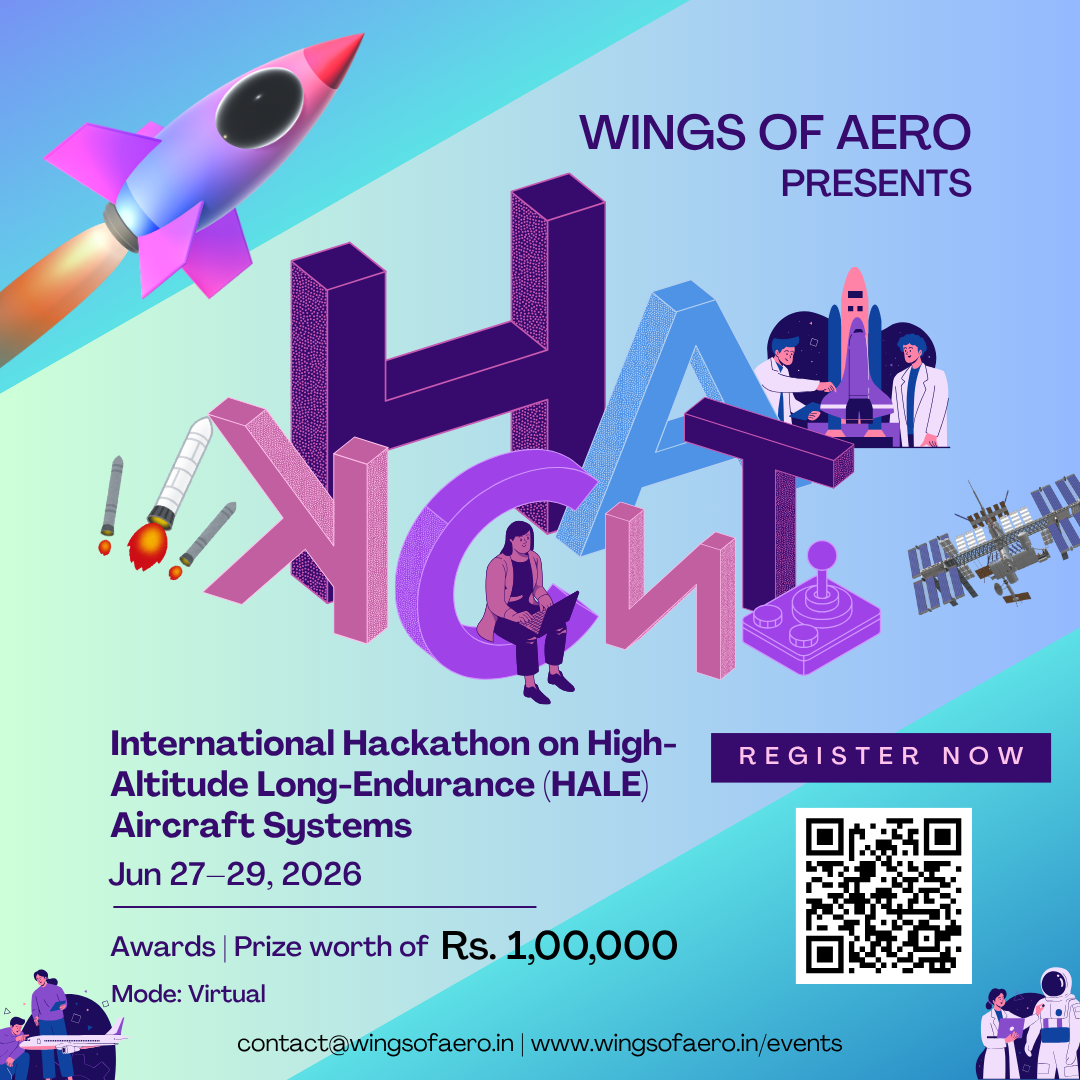
International Hackathon on High-Altitude Long-Endurance (HALE) Aircraft Systems
International Hackathon on High-Altitude Long-Endurance (HALE) Aircraft Systems
June 27–29, 2026 | Online
Organized by: Wings of Aero
Convenor: Ms. Suguna B – Co-Founder & CBO, Wings of Aero
1] About the Hackathon
The International Hackathon on High-Altitude Long-Endurance (HALE) Aircraft Systems invites innovators, students, and researchers from around the globe to develop breakthrough solutions for future high-altitude platforms. HALE aircraft are critical for continuous surveillance, atmospheric research, communication relays, disaster monitoring, border security, and pseudo-satellite applications.
Operating at altitudes of 60,000–90,000 ft, these aircraft encounter extreme challenges: low temperatures, scarce oxygen, limited energy availability, structural loads, and long-duration mission requirements. This hackathon empowers participants to create next-generation HALE systems through advancements in aerodynamics, materials, propulsion, AI-enabled autonomy, energy storage, and mission architecture.
2] Problem Statements / Tracks
Track 1: Ultra-Lightweight Structural Design
Problem: HALE aircraft require extremely lightweight but strong structures to maintain lift at high altitudes.
Expected Solution: Propose a structural design using advanced composites, morphing wings, or load-distributed frameworks optimized for endurance.
Track 2: Solar-Electric Propulsion System Optimization
Problem: Limited energy availability at high altitudes restricts endurance.
Expected Solution: Develop energy-efficient propulsion concepts, solar array integration, and power management algorithms for multi-day to multi-month missions.
Track 3: Aerodynamic Optimization for Thin Air
Problem: Lift generation is difficult in low-density air, increasing wingspan and drag considerations.
Expected Solution: Suggest aerodynamic strategies, high-aspect-ratio wing designs, or CFD-inspired optimizations for stable high-altitude flight.
Track 4: Autonomous Mission Control & Fault Detection
Problem: HALE platforms must self-correct, avoid hazards, and maintain stable flight with minimal human intervention.
Expected Solution: Create AI-driven autonomy solutions for real-time flight control, fault-tolerant systems, or predictive maintenance.
Track 5: High-Altitude Communication Relay Payload
Problem: HALE aircraft can replace satellites for temporary coverage but require robust communication systems.
Expected Solution: Design a lightweight, energy-efficient communication relay payload supporting broadband, surveillance, or emergency response networks.
Track 6: Thermal Management in the Stratosphere
Problem: HALE systems face severe temperature fluctuations affecting batteries, electronics, and structural integrity.
Expected Solution: Develop thermal insulation strategies, active heating concepts, or energy-balanced thermal control systems.
Track 7: Energy Storage for Night Operations
Problem: Solar-powered HALE systems rely heavily on stored energy during night cycles.
Expected Solution: Propose next-generation battery systems, hydrogen storage, regenerative fuel cells, or hybrid energy solutions.
Track 8: Launch, Recovery & Ground Support Challenges
Problem: Large-span HALE aircraft require specialized handling for launch and recovery phases.
Expected Solution: Suggest ground handling systems, autonomous takeoff/landing concepts, or modular assembly techniques.
Track 9: Multi-Mission HALE Payload Integration
Problem: Platforms must support diverse missions (surveillance, weather, communication, environmental monitoring).
Expected Solution: Design modular payload bays, plug-and-play sensors, or flexible mission integration architectures.
Track 10: Individual Innovation Track
Problem: Open category for any new student-driven innovation relevant to HALE aircraft systems.
Expected Solution: Any original concept enhancing endurance, safety, capability, or mission effectiveness.
3] Event Schedule (Three-Day)
Day 1 – June 27, 2026
-
10:00 AM – 11:00 AM: Inaugural Ceremony & Keynote
-
11:00 AM – 1:00 PM: Problem Statement Orientation & Team Setup
-
2:00 PM – 6:00 PM: Hackathon Work Session – Phase 1
-
6:00 PM – 7:00 PM: Mentor Interaction & Q&A
Day 2 – June 28, 2026
-
10:00 AM – 1:00 PM: Hackathon Work Session – Phase 2
-
2:00 PM – 5:00 PM: Prototype Building & Simulation Development
-
5:00 PM – 7:00 PM: Technical Review with Expert Panel
Day 3 – June 29, 2026
-
10:00 AM – 1:00 PM: Final Submission & Pitch Preparation
-
2:00 PM – 5:00 PM: Team Presentations & Live Demos
-
5:00 PM – 6:00 PM: Jury Evaluation
-
6:00 PM – 7:00 PM: Awards & Closing Ceremony
4] Eligibility & Participation Rules
Eligibility
-
Open to students, innovators, and research professionals globally.
-
Team Size: 2–4 members.
Rules
-
Only original concepts developed during the hackathon are allowed.
-
Teams must adhere to ethical standards and respect intellectual property.
-
Professional behavior must be maintained throughout the event.
-
All deadlines, formats, and submission rules must be followed.
-
Any act of plagiarism or misconduct will lead to disqualification.
5] Evaluation Criteria
-
Innovation & Creativity
-
Practical Application / Social Impact
-
Technical Implementation
-
Scalability & Feasibility
-
Presentation Quality
6] Prizes & Recognition
Top 10 Winners
Receive USD 1000 worth vouchers under the
“Idea to Startup Scheme” – SUKISH GROUP
Top 3 Teams
Ideas will be forwarded to leading organizations for seed funding consideration, including:
-
Boeing Research & Technology
-
Airbus Defence & Space
-
Lockheed Martin Skunk Works
-
NASA Armstrong Flight Research Center
-
DRDO – Aeronautical Development Agency
Additional Recognition
-
Certificates of Participation for all teams
-
Special Innovation Category Awards during WOA International Awards 2026 Series
-
Showcase opportunities at related WOA International Conference
-
Selected ideas will be published in the WOA International Journal
7] Registration Section
Indian Teams (4 Members)
Fee: ₹499
Registration Link: https://rzp.io/rzp/OIdx3sUB
International Teams (4 Members)
Fee: USD 50
Registration Link: https://www.paypal.com/ncp/payment/GQX8AYUCPJ7GL
Registration Deadline: June 20, 2026
(One week before the hackathon)
8] Contact Information
📧 Email: contact@wingsofaero.in
🌐 Website: www.wingsofaero.in/events