
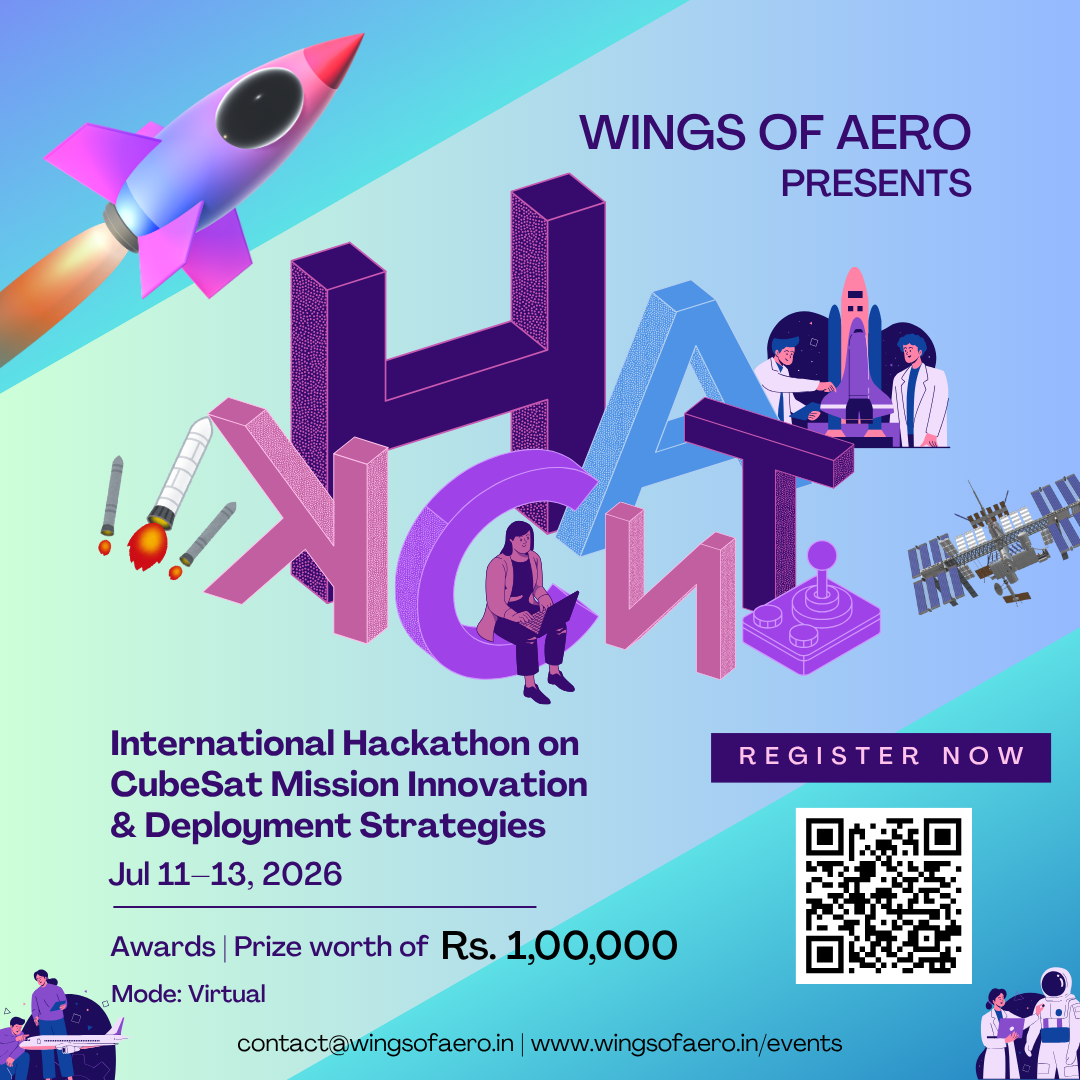
International Hackathon on CubeSat Mission Innovation & Deployment Strategies
International Hackathon on CubeSat Mission Innovation & Deployment Strategies
Dates: July 11–13, 2026
Mode: Online
Organized by: Wings of Aero
Convenor: Ms. Suguna B, Co-Founder & CBO, Wings of Aero
1] About the Hackathon
The International Hackathon on CubeSat Mission Innovation & Deployment Strategies brings together global thinkers, innovators, and engineers to envision the next era of small-satellite missions. CubeSats have revolutionized access to space due to their low cost, rapid development cycle, and versatility across scientific, commercial, and educational domains. However, mission reliability, deployment efficiency, communication, and payload optimization remain critical challenges.
This hackathon aims to empower students, researchers, and professionals to design innovative CubeSat architectures, deployment mechanisms, mission strategies, and subsystems that can support future Earth observation, planetary exploration, astronomy, communication, and technology demonstration missions.
Participants will work on real-world CubeSat challenges inspired by ISRO, NASA, ESA, JAXA, and industry leaders.
2] Problem Statements / Tracks (10 Total)
Track 1: CubeSat Attitude Determination & Control System (ADCS) Optimization
Problem: CubeSats often face instability and limited pointing accuracy due to size constraints.
Expected Solution: Design advanced ADCS algorithms or miniaturized control systems (reaction wheels, magnetorquers, gyros) for precise attitude control.
Track 2: Miniaturized Propulsion Systems for Orbital Adjustments
Problem: Conventional propulsion systems are bulky, expensive, or unsafe for small satellites.
Expected Solution: Propose innovative micro-propulsion concepts (ion, cold gas, electrical, chemical) optimized for CubeSat scale.
Track 3: High-Efficiency Power Management in Miniaturized Platforms
Problem: CubeSats have limited solar-panel surface area, leading to power shortages.
Expected Solution: Create models, circuitry, or deployable architectures to maximize power generation and storage efficiency.
Track 4: Communication Architecture for Multi-CubeSat Constellations
Problem: Constellations require synchronized data exchange and reliable downlink strategies.
Expected Solution: Develop inter-satellite communication protocols, ground-station scheduling, or low-latency links.
Track 5: Thermal Regulation Strategies for Compact Satellites
Problem: Rapid thermal fluctuations in space threaten payload integrity.
Expected Solution: Provide lightweight thermal control solutions (coatings, radiators, heat pipes, materials).
Track 6: Advanced Payload Ideas for Next-Generation CubeSat Missions
Problem: Payloads must be compact yet scientifically impactful.
Expected Solution: Propose new payloads such as space weather sensors, optical instruments, biological experiments, material science payloads, or deep-space demonstrators.
Track 7: CubeSat Deployment Mechanism Innovations
Problem: Current deployment mechanisms can cause tumbling or risk of collision.
Expected Solution: Design safer, more controlled, and reliable deployers or separation systems for launch and deep-space missions.
Track 8: Autonomous Onboard Data Processing & AI-Driven CubeSat Operations
Problem: Downlink bandwidth is limited; raw data cannot always be transmitted efficiently.
Expected Solution: Develop AI-based onboard processing systems for image compression, anomaly detection, failure prediction, or autonomous decision making.
Track 9: CubeSat Space Debris Mitigation Strategies
Problem: With thousands of CubeSats launched, debris management is essential.
Expected Solution: Provide solutions for end-of-life disposal, de-orbiting mechanisms, tracking support, or collision avoidance.
Track 10: Open Innovation Track – Student Concept Challenge
Participants can present any original idea related to CubeSat missions or deployment strategies.
Expected Solution: A creative, technically grounded innovation with clear mission relevance.
3] Event Schedule (Three-Day Hackathon)
📅 Day 1 – July 11, 2026
-
10:00 AM – 10:30 AM: Inaugural Ceremony & Keynote
-
10:30 AM – 11:30 AM: Expert Session on CubeSat Missions
-
11:30 AM – 12:00 PM: Problem Statement Briefing
-
12:00 PM – 5:00 PM: Team Formation & Idea Submission Round 1
📅 Day 2 – July 12, 2026
-
10:00 AM – 1:00 PM: Prototype Design / Simulation / Architecture Development
-
2:00 PM – 4:00 PM: Mentor Review & Technical Feedback
-
4:00 PM – 8:00 PM: Design Refinement & Final Submission
📅 Day 3 – July 13, 2026
-
10:00 AM – 1:00 PM: Final Presentation Preparation
-
2:00 PM – 5:00 PM: Jury Evaluation & Team Presentations
-
5:00 PM – 6:00 PM: Closing Ceremony & Winner Announcements
4] Eligibility & Participation Rules
Eligibility
-
Open to students, researchers, innovators, and professionals worldwide.
-
Team size must be 2–4 members.
Participation Rules & Code of Conduct
-
All ideas must be original and developed during the hackathon.
-
Respectful and professional conduct is mandatory.
-
Plagiarism or inappropriate content leads to disqualification.
-
Teams must adhere to deadlines and submission guidelines.
-
Jury decisions are final and binding.
5] Evaluation Criteria
-
Innovation & Creativity
-
Practical Application / Social Impact
-
Technical Implementation
-
Scalability & Feasibility
-
Presentation Quality
6] Prizes & Recognition
🎉 Awards & Opportunities
Top 10 Teams:
Receive USD 1000 Worth Voucher – “Idea to Startup Scheme” from SUKISH GROUP.
Top 3 Teams:
Ideas will be shared with major space industry organizations for potential seed funding, such as:
-
NASA Small Spacecraft Systems Virtual Institute (SSSI)
-
ISRO Small Satellite Division
-
ESA CubeSat Programme (CLEO)
-
JAXA Innovative Satellites Team
-
Planet Labs / Spire Global
Additional Benefits
-
Certificates of Participation for all teams
-
Special Innovation Awards during WOA International Awards 2026 Series
-
Showcase opportunity at a related WOA International Conference
-
Selected ideas will be published as abstracts in the WOA International Journal
7] Registration Section
Indian Team (4 Members):
💰 Fee: Rs. 499
🔗 Registration Link: https://rzp.io/rzp/OIdx3sUB
International Team (4 Members):
💰 Fee: USD 50
🔗 Registration Link: https://www.paypal.com/ncp/payment/GQX8AYUCPJ7GL
Registration Deadline:
📌 July 4, 2026 (One week before the Hackathon)
8] Contact Information
📧 Email: contact@wingsofaero.in
🌐 Website: www.wingsofaero.in/events