
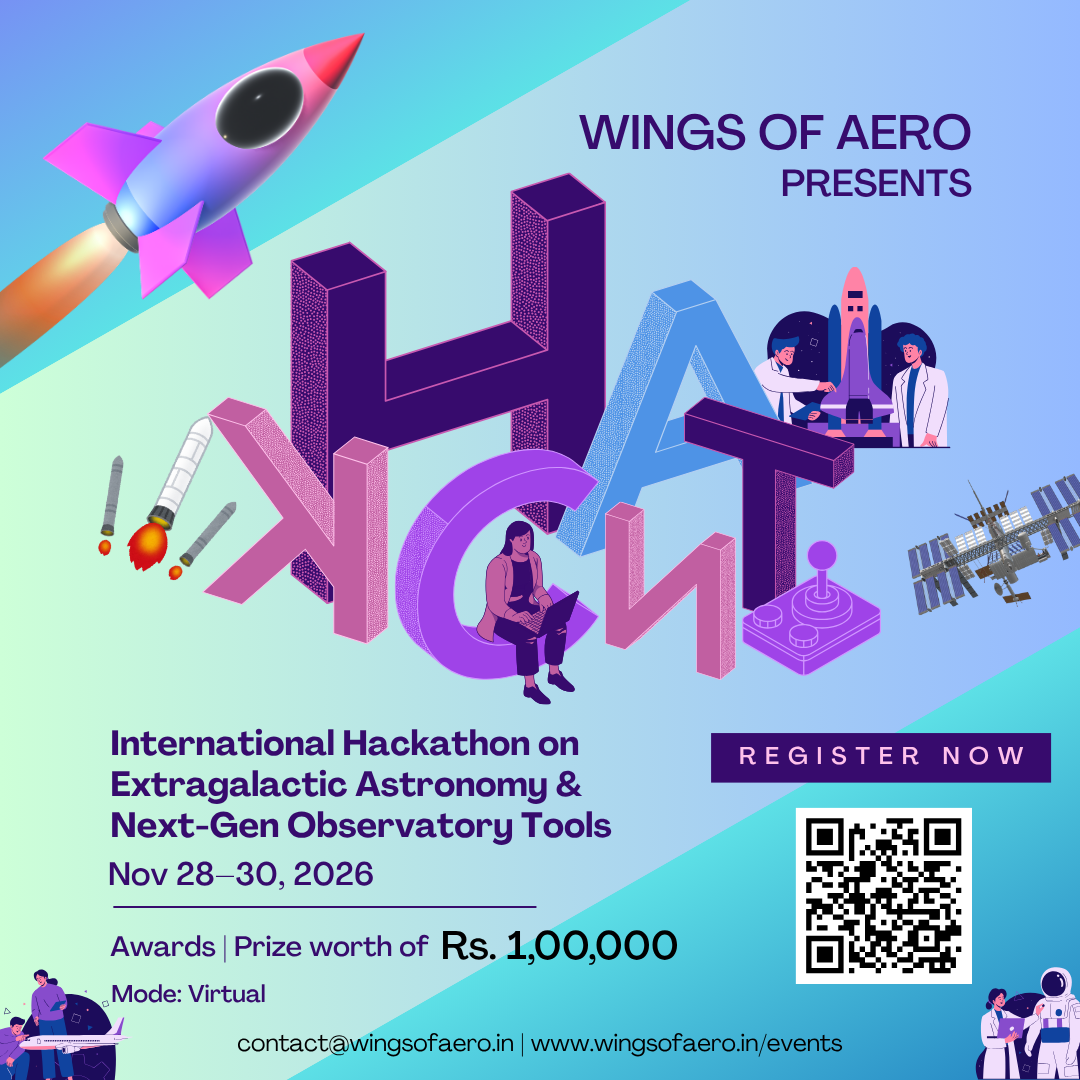
International Hackathon on Extragalactic Astronomy & Next-Gen Observatory Tools
International Hackathon on Extragalactic Astronomy & Next-Gen Observatory Tools
Dates: Nov 28–30, 2026
Mode: Online
Organized by: Wings of Aero
Convenor: Ms. Suguna B – Co-Founder & CBO, Wings of Aero
1] About the Hackathon
The International Hackathon on Extragalactic Astronomy & Next-Gen Observatory Tools is a global innovation challenge designed to bring together space scientists, astrophysics enthusiasts, engineers, data analysts, and AI developers to push the boundaries of how we observe, study, and understand galaxies beyond the Milky Way.
With the rapid evolution of next-generation observatories—such as the James Webb Space Telescope (JWST), Vera Rubin Observatory, Euclid Mission, and future X-ray/IR interferometers—there is an urgent need for advanced imaging tools, automated data-processing pipelines, improved detector technologies, and new methods of deciphering galactic evolution.
This hackathon invites participants to create innovative astronomical tools, observation strategies, AI-powered pipelines, and futuristic instrument concepts that will shape the next era of extragalactic research.
2] Problem Statements / Tracks
1. Galaxy Classification using Advanced AI Models
Problem: Sophisticated extragalactic datasets require automated classification of spiral, elliptical, starburst, merging, and dwarf galaxies.
Expected Solution: Develop machine learning models capable of accurate galaxy classification, anomaly detection, or structure determination.
2. Redshift Estimation Tools for Deep-Space Surveys
Problem: Precise redshift calculation is crucial to understanding cosmic expansion, but current methods are computationally intensive.
Expected Solution: Build a fast, reliable photometric or spectral redshift estimation tool using AI or hybrid computational methods.
3. High-Resolution Galaxy Imaging Reconstruction
Problem: Distant galaxies appear faint and blurred, limiting morphological analysis.
Expected Solution: Create super-resolution algorithms or deconvolution tools to enhance deep-space imagery from telescopes.
4. Dark Matter Halo Mapping for Galaxy Clusters
Problem: Dark matter distribution around extragalactic clusters is difficult to map with limited visible data.
Expected Solution: Develop models using gravitational lensing data, machine learning inference, or simulation pipelines for halo visualization.
5. Tools for Identifying Extragalactic Transients
Problem: Supernovae, gamma-ray bursts, and tidal disruption events occur unpredictably and are hard to detect early.
Expected Solution: Build real-time alert systems or detection models using multi-wavelength survey data.
6. Next-Gen Infrared / X-Ray Detector Design Concepts
Problem: Deep extragalactic observations require ultra-sensitive detectors with minimal noise interference.
Expected Solution: Propose innovative detector architecture or compact design concepts inspired by upcoming observatory technology.
7. Cosmological Simulation Acceleration Tools
Problem: Large cosmological simulations (galaxy formation, dark matter dynamics) are computationally expensive.
Expected Solution: Create optimization algorithms, GPU-accelerated tools, or AI-assisted simulation frameworks.
8. Observatory Automation & Smart Scheduling System
Problem: Multi-telescope scheduling to maximize extragalactic data collection is challenging.
Expected Solution: Build an automated scheduling platform that prioritizes regions of interest based on weather, telescope availability, and ongoing events.
9. Inter-Galactic Medium (IGM) Mapping Tools
Problem: IGM structures are difficult to reconstruct due to sparse observational data.
Expected Solution: Design analytical tools leveraging quasar absorption lines, AI reconstruction, or hybrid simulation–observational methods.
10. Individual Innovation Track (Open Theme)
Participants may propose any novel tool, instrument, data-processing pipeline, visualization system, or detectability method aligned with extragalactic astronomy or observational instrumentation.
3] Event Schedule (Three-Day)
📅 Day 1 – Nov 28, 2026
-
10:00 AM – 11:00 AM: Inauguration & Theme Overview
-
11:00 AM – 1:00 PM: Expert Talk: Future of Extragalactic Observation
-
2:00 PM – 5:00 PM: Team Formation & Problem Track Selection
-
5:00 PM – 7:00 PM: Hackathon Kickoff – Research & Ideation
📅 Day 2 – Nov 29, 2026
-
10:00 AM – 1:00 PM: Mentorship Round
-
2:00 PM – 6:00 PM: Prototype / Algorithm / Model Development
-
7:00 PM – 9:00 PM: Midway Submission & Feedback
📅 Day 3 – Nov 30, 2026
-
10:00 AM – 1:00 PM: Final Development & Pitch Preparation
-
2:00 PM – 5:00 PM: Final Presentations & Jury Review
-
6:00 PM – 7:00 PM: Awards & Closing Ceremony
4] Eligibility & Participation Rules
Team Size: 2–4 Members
Eligibility
-
UG, PG, PhD students
-
Researchers & early-career astronomers
-
Data scientists & AI enthusiasts
-
Space instrumentation developers
-
Professionals from academia / industry
Code of Conduct
-
Original work only; plagiarism prohibited
-
Respect fellow participants, mentors, and judges
-
AI tools allowed with disclosure
-
Maintain professionalism throughout
-
Judges’ decisions are final
5] Evaluation Criteria
-
Innovation & Creativity
-
Practical Application / Scientific Impact
-
Technical Implementation & Rigor
-
Scalability & Feasibility
-
Presentation Quality & Clarity
6] Prizes & Recognition
🎉 Top 10 Winners
Receive USD 1000 voucher under
SUKISH GROUP’s “Idea to Startup Scheme”
🌟 Top 3 Ideas
Shared with global organizations for Seed Funding Support, including:
-
NASA – Goddard Space Flight Center
-
European Space Agency (ESA)
-
Square Kilometre Array Observatory (SKAO)
-
Carnegie Observatories
-
Max Planck Institute for Astronomy
Additional Benefits
-
Certificates for all participants
-
Special Innovation Awards at WOA International Awards 2026
-
Opportunity to present at related WOA International Conference
-
Selected ideas published in WOA International Journal
7] Registration Section
Indian Team (4 Members): Rs. 499
Registration Link: https://rzp.io/rzp/OIdx3sUB
International Team (4 Members): USD 50
Registration Link: https://www.paypal.com/ncp/payment/GQX8AYUCPJ7GL
Registration Deadline: Nov 21, 2026
8] Contact Information
📧 Email: contact@wingsofaero.in
🌐 Website: www.wingsofaero.in/events