
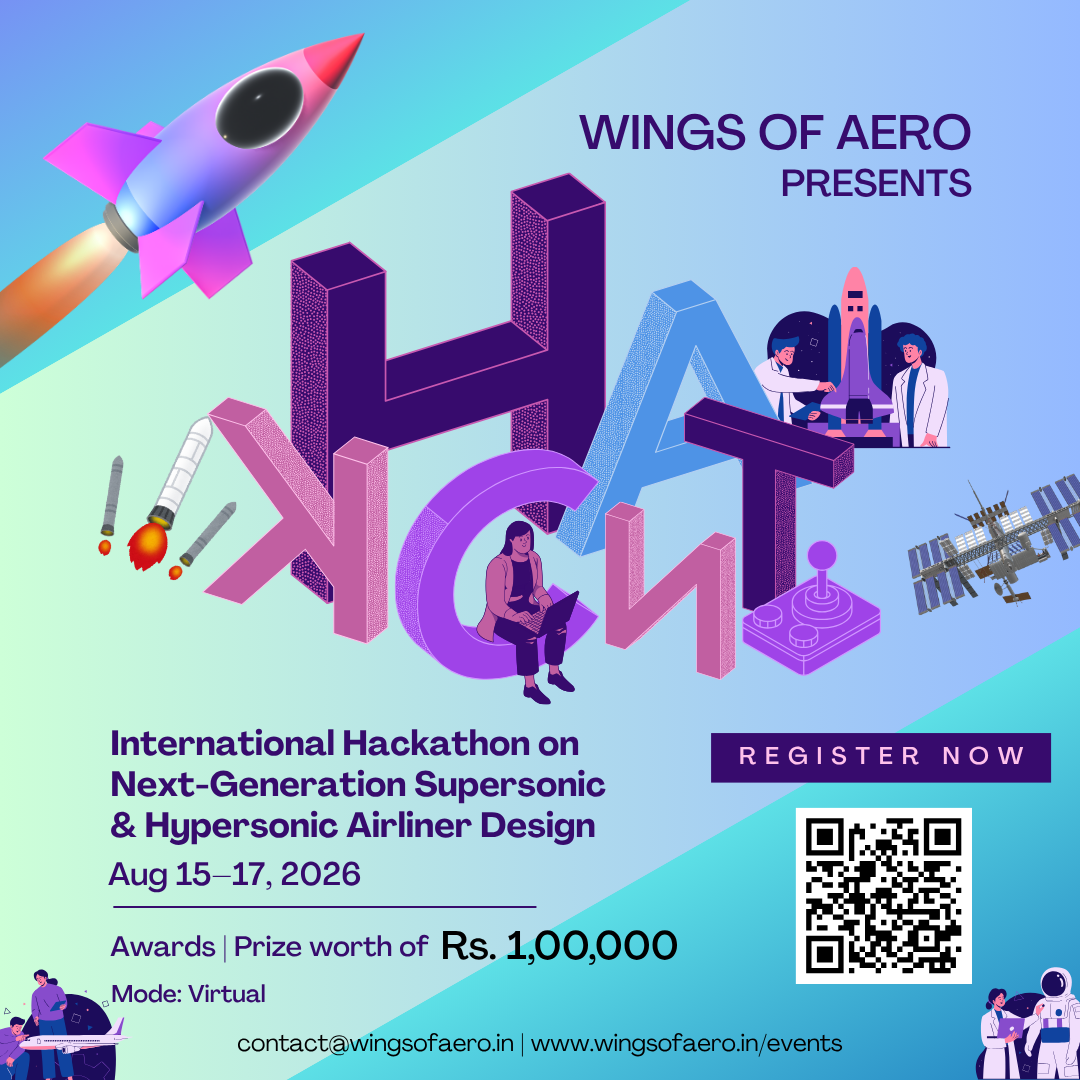
International Hackathon on Next-Generation Supersonic & Hypersonic Airliner Design
International Hackathon on Next-Generation Supersonic & Hypersonic Airliner Design
Dates: August 15–17, 2026
Mode: Online
Organized by: Wings of Aero
Convenor: Ms. Suguna B – Co-Founder & CBO, Wings of Aero
1] About the Hackathon
The International Hackathon on Next-Generation Supersonic & Hypersonic Airliner Design brings together innovators, students, researchers, and aviation enthusiasts to solve real-world challenges in high-speed commercial aviation. As global demand for rapid travel grows, the future of airliners lies in technologies capable of cruising at Mach 2–7, while ensuring safety, efficiency, environmental sustainability, and passenger comfort.
This 3-day global event provides a collaborative platform to ideate, design, simulate, and present breakthrough concepts in aerodynamics, propulsion, materials, cabin systems, noise reduction, thermal protection, mission planning, and sustainable technologies for ultra-high-speed air transportation. Participants will gain exposure to cutting-edge aerospace problems, mentorship, and opportunities for innovation recognition.
2] Hackathon Problem Statements / Tracks
Below are 9 real-world problem tracks plus 1 innovation-only track. Each problem includes the challenge description and expected solution approach.
Track 1: Aerodynamic Design for High-Speed Efficiency
Problem: Design a supersonic/hypersonic airliner aerodynamic configuration that minimizes drag, reduces sonic boom strength, and ensures stability across transonic to hypersonic regimes.
Expected Solution: Concept sketches, CFD-based reasoning, wing-body-tail configurations, shockwave mitigation strategies (e.g., area ruling, chine design), stability analysis.
Track 2: Next-Gen Propulsion System for Mach 2–7 Airliners
Problem: Develop a propulsion concept (turbofan–ramjet, turbo-ramjet, scramjet, or hybrid combined-cycle engine) suitable for commercial hypersonic flights.
Expected Solution: Engine cycle diagrams, airflow management approach, thermal management concepts, fuel type considerations, thrust efficiency analysis.
Track 3: Thermal Protection Materials & Heat Management Systems
Problem: Airliners travelling above Mach 4 face extreme aero-heating on leading edges and fuselage surfaces.
Expected Solution: Material proposals (e.g., CMCs, ablatives, nano-composites), active/passive cooling systems, thermal modelling, structural integration methods.
Track 4: Low-Noise Takeoff & Landing for Supersonic Aircraft
Problem: Supersonic engines generate high noise levels during low-speed operations.
Expected Solution: Noise-reduction nozzles, acoustic liners, variable-cycle engines, hybrid-electric taxi systems, or novel takeoff-assist concepts.
Track 5: Sustainable Fuel Solutions for High-Speed Commercial Travel
Problem: Supersonic and hypersonic flight drastically increases fuel burn and emissions.
Expected Solution: SAF integration, hydrogen/cryogenic systems, energy-efficient flight profiles, lifecycle carbon impact assessment.
Track 6: Passenger Comfort & Cabin Safety at Extreme Speeds
Problem: Designing cabins for high dynamic pressures, temperatures, accelerations, and noise while maintaining comfort.
Expected Solution: Cabin pressurization models, vibration/noise damping, safety features, ergonomic seating, emergency systems adapted for high-speed operations.
Track 7: Flight Control & Autonomous Systems for High-Speed Aircraft
Problem: High-speed aircraft require rapid control input, advanced sensors, and AI-based guidance.
Expected Solution: Control algorithms, sensor fusion concepts, AI-assisted piloting, stability augmentation systems, automated emergency override.
Track 8: Structural Design for Reusability & Long-Duration Service Life
Problem: Supersonic/hypersonic structures face fatigue, thermal cycling, microcracks, and high loads.
Expected Solution: Structural layout, load analysis, fatigue/thermal-cycle mitigation strategies, smart materials, modular/repairable structures.
Track 9: Airport & Infrastructure Requirements for High-Speed Airliners
Problem: Existing airports are not suited for hypersonic aircraft operations.
Expected Solution: Concepts for runways, thermal-safe gates, fuel storage, maintenance facilities, regulatory considerations, ground support systems.
Track 10 (Open Innovation Track): Individual Student Innovation
Participants may submit any unique idea or innovation aligned with supersonic/hypersonic commercial airliner technology.
Expected Solution: Novel systems, futuristic vehicle concepts, innovative materials, or breakthrough propulsion or safety ideas.
3] Event Schedule (Three Days)
Day 1 – August 15, 2026
-
10:00 AM – 11:00 AM: Opening Ceremony & Theme Introduction
-
11:00 AM – 1:00 PM: Mentor Talks & Technical Orientation
-
1:00 PM – 2:00 PM: Team Formation & Problem Finalization
-
2:00 PM – 6:00 PM: Hackathon Kickoff – Work Session 1
Day 2 – August 16, 2026
-
10:00 AM – 1:00 PM: Work Session 2 (Mentor Check-ins)
-
1:00 PM – 2:00 PM: Break
-
2:00 PM – 6:00 PM: Work Session 3 – Prototype/Model Development
Day 3 – August 17, 2026
-
10:00 AM – 1:00 PM: Final Submission & Presentation Preparation
-
2:00 PM – 5:00 PM: Project Presentations & Jury Evaluation
-
5:00 PM – 6:00 PM: Awards Ceremony & Closing Note
4] Eligibility & Participation Rules
Team Size:
-
2 to 4 members per team
Eligibility:
-
Open to students, researchers, innovators, and professionals from any discipline related to aerospace, mechanical engineering, robotics, computer science, physics, or innovation.
-
No prior experience in supersonic/hypersonic design required.
Participation Rules & Code of Conduct:
-
All submissions must be original and created during the hackathon.
-
Teams must maintain respectful, ethical, and professional conduct.
-
Plagiarism or use of confidential industry data is prohibited.
-
Decisions of the evaluation panel are final.
-
Cross-institutional teams are allowed.
5] Evaluation Criteria
-
Innovation & Creativity – Novelty and uniqueness of the solution.
-
Practical Application / Social Impact – Real-world feasibility and benefits.
-
Technical Implementation – Engineering soundness and clarity.
-
Scalability & Feasibility – Potential for commercial use and future development.
-
Presentation Quality – Communication, clarity, and structure of the final pitch.
6] Prizes & Recognition
🏆 Awards & Opportunities
-
Top 10 Winners:
Receive USD 1000 Voucher – Idea to Startup Scheme of SUKISH GROUP. -
Top 3 Ideas:
Will be shared with leading companies/research organizations for Seed Funding Support, including:-
NASA
-
Airbus
-
Boeing
-
Lockheed Martin
-
DARPA
-
-
All Participants:
-
Certificate of Participation
-
Opportunity to showcase at relevant WOA International Conferences
-
Selected ideas will be published as abstracts in WOA International Journal
-
Eligible for Innovation Awards under WOA International Awards 2026 Series
-
7] Registration Section
Indian Team (Up to 4 Members):
-
Fee: Rs. 499
-
Registration Link: https://rzp.io/rzp/OIdx3sUB
International Team (Up to 4 Members):
-
Fee: USD 50
-
Registration Link: https://www.paypal.com/ncp/payment/GQX8AYUCPJ7GL
Registration Deadline:
August 8, 2026 (One week before the hackathon)
8] Contact Information
-
Email: contact@wingsofaero.in
-
Website: www.wingsofaero.in/events