
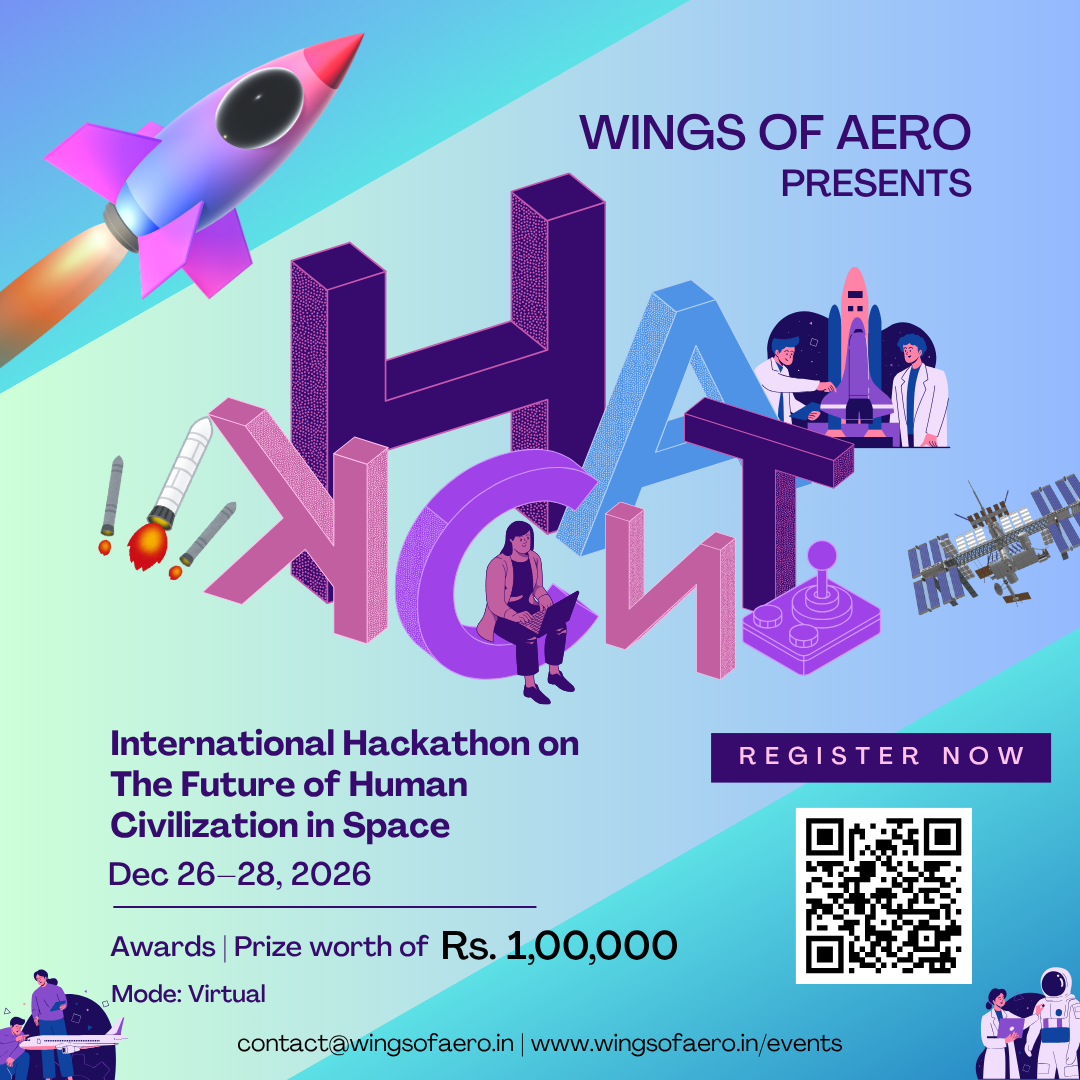
International Hackathon on The Future of Human Civilization in Space
International Hackathon on The Future of Human Civilization in Space
Date: December 26–28, 2026
Mode: Online
Organized by: Wings of Aero
Convenor: Ms. Suguna B – Co-Founder & CBO, Wings of Aero
1] About the Hackathon
Humanity stands at the threshold of becoming a multi-planetary civilization. The International Hackathon on The Future of Human Civilization in Space is a global innovation platform designed to explore bold ideas, futuristic technologies, sustainable living systems, and societal frameworks that will shape our long-term existence beyond Earth.
Participants will address critical challenges in space settlement, interplanetary governance, extraterrestrial habitats, space agriculture, space economy, health & psychology in deep space, and future human–AI coexistence.
This hackathon encourages multidisciplinary thinking, creativity, and entrepreneurial vision to imagine how humanity will thrive in space over the next century.
2] Problem Statements / Tracks
Track 1: Sustainable Space Habitat & Architecture
Problem: Long-term living in space requires robust, radiation-shielded, energy-efficient habitats that support human life.
Expected Solution: Propose structural designs, materials, shielding systems, or closed-loop infrastructure for habitats on the Moon, Mars, orbital stations, or deep-space vessels.
Track 2: Interplanetary Food Production & Space Agriculture
Problem: Future settlers need reliable food systems independent of Earth supply.
Expected Solution: Develop hydroponic, aeroponic, bioengineered, or AI-managed food production systems optimized for reduced gravity and harsh environments.
Track 3: Space Governance & Interplanetary Law Frameworks
Problem: Humanity lacks a clear structure for governance, property rights, security, and ethics in space settlements.
Expected Solution: Suggest policy frameworks, governance models, AI-based administration systems, or ethical guidelines for multi-planetary societies.
Track 4: Health, Medicine & Human Psychology in Deep Space
Problem: Space radiation, isolation, low gravity, and long missions pose serious medical and psychological challenges.
Expected Solution: Propose remote medical systems, mental health tools, adaptive biological solutions, or habitability modules to ensure human well-being.
Track 5: Future Space Economy & Interplanetary Trade
Problem: Sustainable long-term civilization requires new economic models for resource exchange, manufacturing, and trade between planets.
Expected Solution: Design business models, digital currency frameworks, interplanetary logistics systems, or space mining value chains.
Track 6: AI–Human Coexistence for Space Civilization
Problem: Future space societies will depend heavily on AI for safety, governance, maintenance, and exploration.
Expected Solution: Create models for collaborative AI-human workforce systems, autonomous colony management, ethical AI roles, or mission-critical AI frameworks.
Track 7: Space Mobility & Transportation Systems of the Future
Problem: Efficient movement between Earth, Moon, Mars, and space stations is critical for civilization growth.
Expected Solution: Propose new propulsion systems, space mobility services, reusable space vehicles, interplanetary shuttle concepts, or logistics platforms.
Track 8: Climate Engineering & Planetary Sustainability
Problem: Establishing long-term colonies may require planetary modification and environment stabilization.
Expected Solution: Present terraforming concepts, atmosphere-generation strategies, ecological balancing methods, or climate-controlled ecosystem designs.
Track 9: Cultural, Educational & Social Structures for Space Communities
Problem: A new civilization must define culture, education, social norms, and community building.
Expected Solution: Develop futuristic education systems, cultural preservation methods, community bonding platforms, or hybrid virtual-physical learning models.
Track 10: Individual Student Innovation Challenge
Theme: Any Unique Concept on the Future of Space Civilization
Expected Solution: Bold, original ideas—technological, societal, philosophical, or entrepreneurial—that contribute to the long-term survival and growth of human civilization in space.
3] Event Schedule (Three-Day)
📅 Day 1 – December 26, 2026
-
10:00 AM – 11:00 AM: Inaugural Ceremony & Theme Introduction
-
11:00 AM – 1:00 PM: Problem Statements Overview
-
1:00 PM – 5:00 PM: Ideation & Concept Research
-
5:00 PM – 6:00 PM: Mentor Interaction Round 1
📅 Day 2 – December 27, 2026
-
10:00 AM – 1:00 PM: Prototype/Concept Development
-
2:00 PM – 4:00 PM: Mentor Interaction Round 2
-
4:00 PM – 7:00 PM: Mid-Review Submission
-
7:00 PM – 8:00 PM: Jury Feedback Session
📅 Day 3 – December 28, 2026
-
10:00 AM – 2:00 PM: Final Report & Presentation Preparation
-
2:00 PM – 5:00 PM: Final Presentations to Jury
-
6:00 PM – 7:00 PM: Winners Announcement & Closing Ceremony
4] Eligibility & Participation Rules
Team Size:
-
2–4 members
Eligibility:
Open for students, researchers, professionals, space enthusiasts, and innovators worldwide.
Code of Conduct:
-
All submissions must be original and ethically created.
-
Respectful collaboration is mandatory.
-
AI use must be transparent.
-
No plagiarism or copyrighted misuse.
-
Jury decisions are final and binding.
5] Evaluation Criteria
-
Innovation & Creativity
-
Practical Application / Social Impact
-
Technical Implementation
-
Scalability & Feasibility
-
Presentation Quality & Clarity
6] Prizes & Recognition
🏆 Top 10 Winning Teams
Awarded USD 1000 Voucher
under the “Idea to Startup Scheme” – SUKISH GROUP
🏅 Top 3 Ideas – Seed Funding Access
Ideas will be shared with major agencies for potential support:
-
NASA – Human Exploration & Operations Mission Directorate
-
ESA – Directorate of Human and Robotic Exploration
-
ISRO – Space Applications & Exploration Initiatives
-
Blue Origin – Advanced development programs
-
SpaceX – Mars & Starship-related innovation programs
📜 Certificates
Certificates of Participation for all.
🌟 Special Category
Innovation Awards – WOA International Awards 2026 Series
🎤 Showcase Opportunity
Winners will present at relevant WOA International Conferences
📘 Publication
Selected ideas will be published in the WOA International Journal
7] Registration Section
Indian Team (Up to 4 Members):
Fee: ₹499
Registration Link: https://rzp.io/rzp/OIdx3sUB
International Team (Up to 4 Members):
Fee: USD 50
Registration Link: https://www.paypal.com/ncp/payment/GQX8AYUCPJ7GL
Registration Deadline:
December 19, 2026 (one week before the hackathon)
8] Contact Information
📩 Email: contact@wingsofaero.in
🌐 Website: www.wingsofaero.in/events